
Make your next scholarship move.
Get new scholarship guides and application updates in one daily email. Confirm your choice and unsubscribe whenever you like.
Continuing creates or signs in to your free reader account. Newsletter emails are optional. Terms · Privacy policy
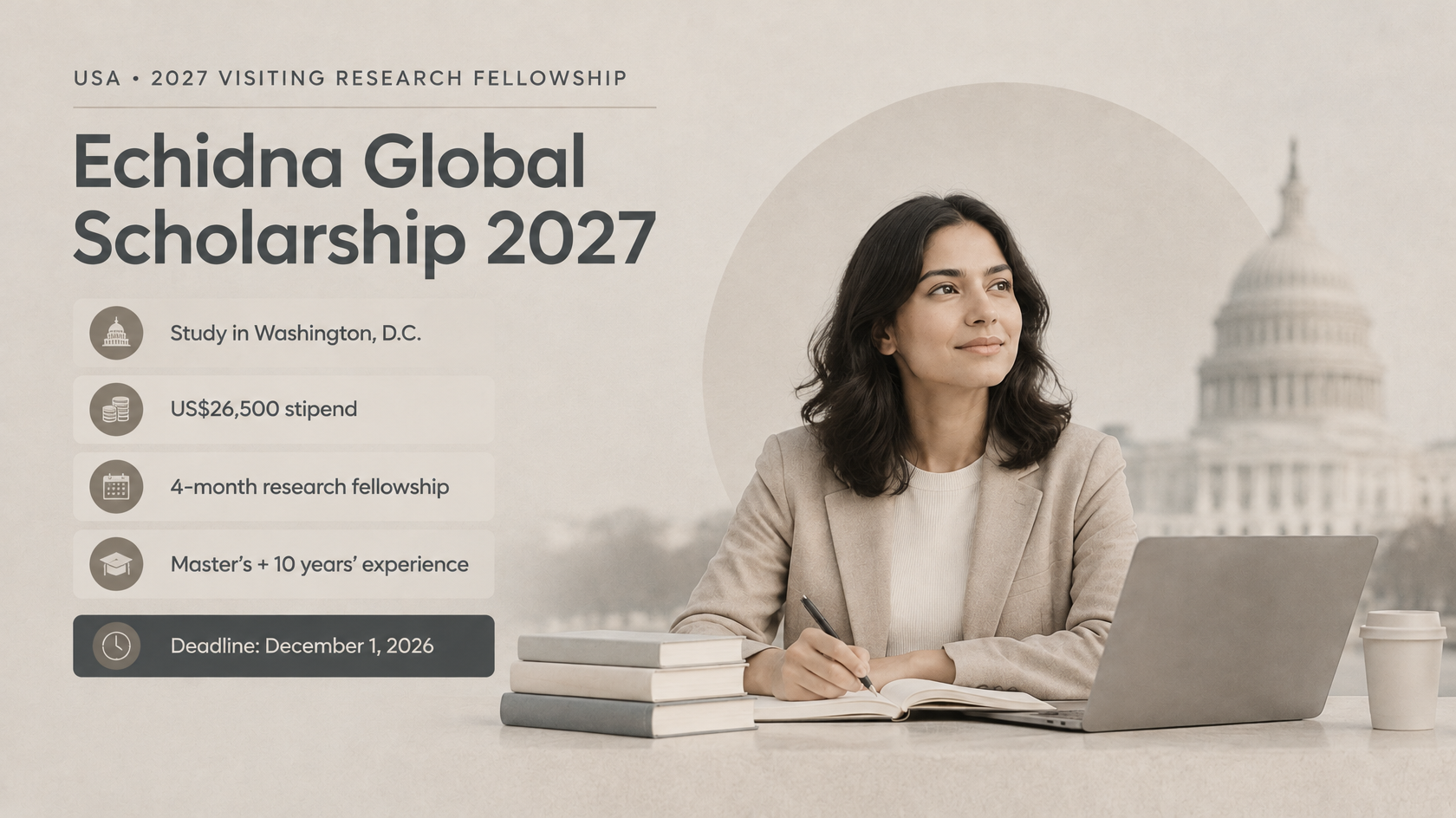
USA • 2027 Visiting Research Fellowship
Could Your Work in Education Take You to Washington, D.C.?
A $26,500 stipend, accommodation and international travel sound attractive. But this Brookings fellowship is not for everyone. Find out whether your experience qualifies, what your research needs to demonstrate, and how to apply without wasting effort.
If you have spent years trying to improve education in your country, perhaps helping girls remain in school, advising education ministries or leading community programmes, you may have encountered a frustrating problem: you can see what needs changing, but lack the research time, international connections or policy platform to make decision-makers listen.
That is where the Echidna Global Scholars Program becomes interesting. Brookings offers experienced professionals from the Global South an opportunity to investigate an education challenge, strengthen their policy research skills and spend four months working with researchers in Washington, D.C. You do not need to be seeking another university degree. You do need a serious professional record and a convincing plan to improve education.
Your applicant’s Quick Opportunity Review box
Open for 2027
December 1, 2026
US$26,500 total
Master’s + 10 years’ experience
Brookings • Washington, D.C.
Proficiency required; IELTS not specified
Official information reviewed November 17, 2026. The stipend is subject to applicable tax rules.
01. Do you actually qualify for Echidna?
Yes, potentially, if you are an experienced education or development professional with strong Global South ties, a master’s degree and at least ten years of relevant work. Your title need not literally say “gender researcher.” An education ministry adviser, NGO director, academic, programme leader or policy professional may have relevant experience.
What matters is whether you can connect your existing work to gender equality in education and show how the fellowship would help you influence decisions back home. Brookings expects fellows to return to their contexts and use what they learn. English communication and the ability to participate fully also matter.
02. Will the funding realistically cover your stay?
Brookings provides a total US$26,500 stipend and separately covers several major residency expenses. That makes this more substantial than an unpaid visiting-research placement, but do not mistake the stipend for a monthly salary or assume every personal expense is reimbursed.
total stipend
single-occupancy housing
round-trip international journey
Additional support includes visa-process costs, a research-design retreat and limited health insurance. The fellowship involves pre-residency research beginning around mid-June 2027 and a full-time Washington residency during August–December 2027; confirm the precise four-month residency dates with Brookings before arranging leave.
Your budget question: Are you travelling alone, and can you manage any uncovered personal costs or tax withholding? Family travel and dependent accommodation are not established benefits in the published package. Ask Brookings before committing to those expenses.
03. What kind of research idea could make your application convincing?
Choose one real education barrier you understand from professional experience, then explain how your findings could inform a practical decision. Brookings asks for a research proposal of roughly three to five pages. You are not expected to solve every education inequality in one project.
Suppose you work in a region where girls often leave school after grade eight. Rather than proposing a broad essay on “the importance of girls’ education,” investigate a specific question: Are transport safety, school costs or local policy gaps driving dropout? Which records and interviews could help you test the explanation? Who could use your findings—a district education office, ministry or school network?
Brookings highlights areas including learning and skills, secondary completion, transitions to further study or work, and challenges linked to conflict, displacement, climate shocks and gender-based violence. Choose the area where your experience gives you genuine insight, not simply the one that sounds most fashionable.
04. Which documents should you prepare first?
Start with the official Echidna application document, not a generic scholarship motivation letter. The initial submission requires your CV or résumé and the completed programme document containing the questionnaire and research proposal.
| Document | What the reviewer needs to see |
|---|---|
| CV / résumé | Leadership, relevant experience, research, measurable results and education |
| Programme application document | Completed questionnaire and 3–5-page proposal |
| References / transcripts | Not required at the initial submission stage; additional evidence may be requested later |
Common mistake: Treating the upload field labelled “Writing sample” as a request for an unrelated essay. Brookings instructs candidates to upload the completed Echidna application document in that field. Follow the file-naming instructions in the official vacancy.
05. How should you submit your application?
- Check your fit before writing. Read the official programme requirements and confirm your qualifications and availability.
- Open the actual vacancy. Visit the Brookings iCIMS application portal and download the linked programme application document.
- Build your application around evidence. Complete the questionnaire, write your proposal, and make sure your CV supports the achievements you describe.
- Upload the right files. Attach your CV and place the completed Echidna document in the “Writing sample” field, following the stated filename format.
- Submit and retain confirmation. Do not wait until the final hour to discover an upload or account problem.
FINAL APPLICATION DEADLINE
December 1, 2026
11:59 p.m. U.S. Eastern Standard Time. Complete applications only.
Brookings lists initial telephone screenings for December 7–18, 2026, further interviews in January–February 2027 and selection invitations around February 16, 2027. These are planning milestones, not a promise of an interview.
06. Questions worth settling before you apply
Can a first-year university student apply?
No. This fellowship is for experienced professionals with a master’s degree and at least ten years of relevant experience. It does not fund undergraduate admission.
Must I submit IELTS?
Brookings requires English proficiency but does not identify IELTS as a universal mandatory application document. Candidates needing visa sponsorship may be assessed for English ability.
Will Brookings sponsor an H-1B visa?
No. The published fellowship uses the J-1 exchange visitor visa process for the U.S. residency. Visa support does not guarantee approval.
What if my job is not specifically in gender equality?
You may still be competitive if you can convincingly connect your professional experience and proposed research to gender equality through education. Other eligibility rules still apply.
Can I continue my full-time job during the U.S. residency?
Do not assume so. The residency is a full-time, exclusive commitment of approximately 40 hours weekly. Arrange employer leave and other responsibilities before accepting an offer.
A final word from your scholarship mentor
If your career has already given you evidence of an education problem that deserves policy attention, this fellowship could help you turn practical experience into research with a wider audience. Your strongest asset is not a polished statement about changing the world; it is a credible record of work, a specific unanswered question and a realistic plan for using the results.
If you are only beginning university, save your energy for scholarships that actually fund undergraduate study. Choosing opportunities that match your stage is itself a smart scholarship strategy.
Official sources: Programme homepage · Eligibility and process · Application vacancy
Your next opportunity, in your inbox.
Get new scholarship guides and application updates in one daily email. Confirm your choice and unsubscribe whenever you like.
Continuing creates or signs in to your free reader account. Newsletter emails are optional. Terms · Privacy policy

