Global COOP Scholarships 2027: Study in France, Argentina, Italy, Brazil, Colombia, and India

Make your next scholarship move.
Get new scholarship guides and application updates in one daily email. Confirm your choice and unsubscribe whenever you like.
Continuing creates or signs in to your free reader account. Newsletter emails are optional. Terms · Privacy policy
GLOBAL COOP Scholarship 2027
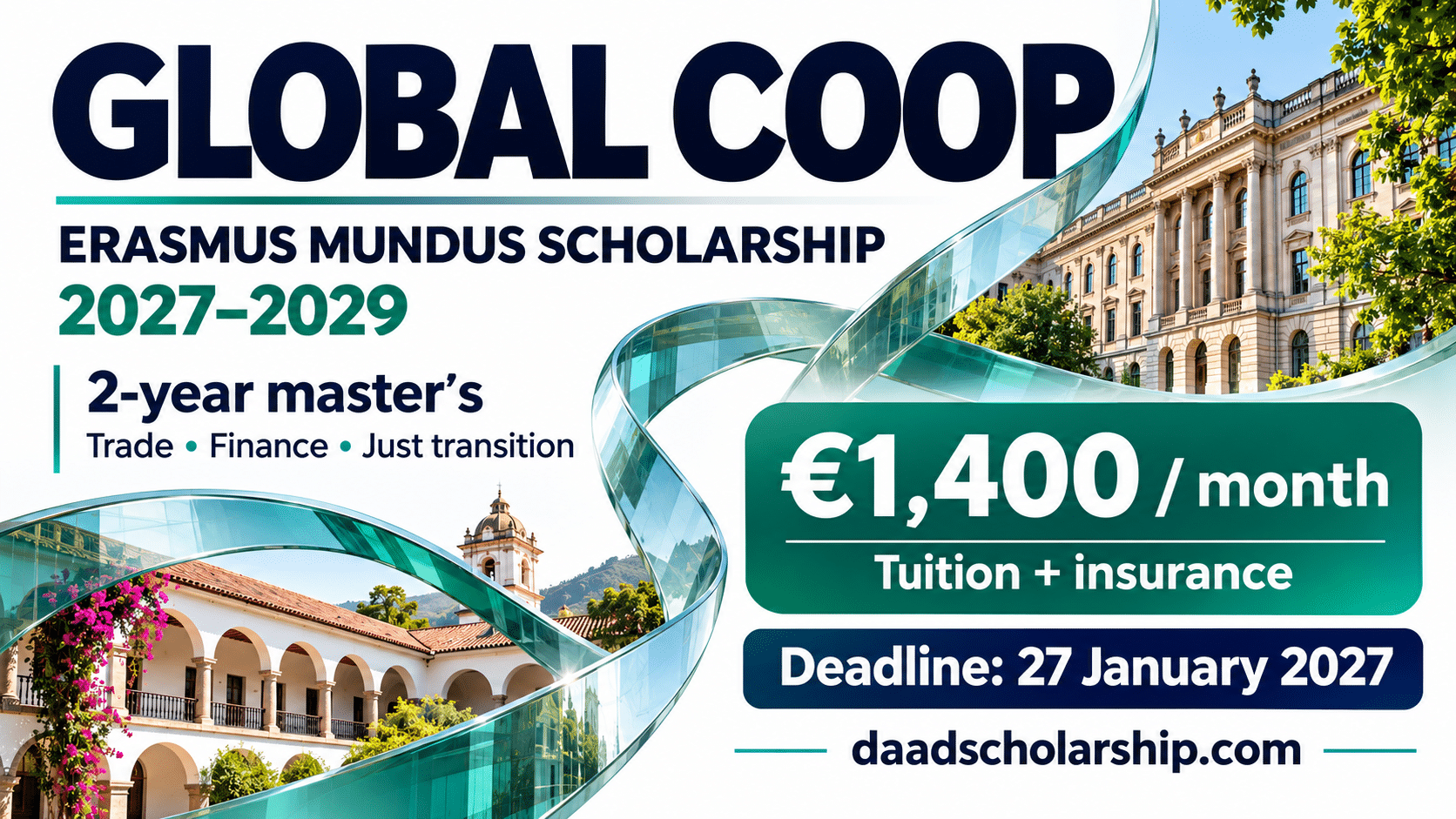
The GLOBAL COOP Erasmus Mundus Joint Master is accepting applications for 2027–2029, offering selected students tuition coverage, insurance and €1,400 monthly during both academic years. The programme brings European and Global South partners together to study economic policies for new global cooperation and alliances.
If trade, financial instability or the green transition is the problem you want to investigate, your next decision is the academic track. Your degree title alone does not settle eligibility: the committee needs evidence of your economics and quantitative preparation.
- Where will you study? Countries and universities
- Which GLOBAL COOP track can you support with evidence?
- What does GLOBAL COOP funding cover?
- How do you prove academic and English readiness?
- What should final-year applicants resolve before applying?
- How to apply for admission and scholarship
- Applicant questions, answered
- GLOBAL COOP scholarship application deadline
Where will you study? Countries and universities
Your option determines Semester 1, while your track determines Semesters 2 and 3. These are alternative routes: you do not study at every university or visit all six countries listed below. Your Semester 4 location depends on your master’s thesis project and the programme’s mobility rules.
Sorbonne Université
Université Sorbonne Nouvelle – Paris 3
Semester 2 for Track 2.
Semester 3 for Tracks 1 and 2.
Which GLOBAL COOP track can you support with evidence?
Choose a track by the policy question you want to understand, then check its degree conditions. GLOBAL COOP’s three directions cover international trade, the international monetary and financial system, and a just socioecological transition. Partner institutions and degrees vary with the pathway.
| Academic route | What applicants must demonstrate |
|---|---|
| Economics graduate | A recognised degree and suitable economics preparation. |
| Graduate from another field | At least 24 ECTS or equivalent in economics and 6 ECTS in statistics or econometrics. |
| Track 1 | At least a four-year degree, or a three-year bachelor’s plus one year of master’s study or equivalent. |
What does GLOBAL COOP funding cover?
The Erasmus Mundus award pays tuition, including the programme’s health and accident insurance, and a €1,400 monthly allowance through both academic years. It is awarded competitively; an academic place can be offered without a scholarship.
Previous EMJM scholarship recipients cannot obtain another EMJM award, and scholars cannot receive another EU grant during their funded studies. I would decide whether you can accept an unfunded place before selecting any conditional-funding option in the form.
How do you prove academic and English readiness?
Use your transcripts and the institution’s grading explanation to show the required preparation. The published academic-record criterion asks for at least 70% of the maximum bachelor’s grading scale; avoid inventing a GPA conversion. If your local credits differ from ECTS, explain their workload and conversion in the optional attachment.
Accepted English options include IELTS Academic 7.0, TOEFL iBT 95 and PTE Academic 67, with other C1-level options listed. An entirely English-taught higher-education degree can support an exemption. The instructions permit pending language evidence with the prescribed declaration, but the required proof must arrive by 10 June.
What should final-year applicants resolve before applying?
The admission instructions ask final-year candidates to graduate by 31 July and supply degree certificates by 31 August, while the FAQ gives a later graduation limit. Plan to meet the earlier instruction and obtain written clarification if your graduation falls in August.
Do not email the application documents as a substitute for the portal. Use the online form, select your track preferences carefully and give referees time to complete their part.
How to apply for GLOBAL COOP admission and scholarship
- Read the official admission instructions and compare the academic conditions for your preferred tracks.
- Open the joint EPOG and GLOBAL COOP application platform and choose the GLOBAL COOP two-year 2027–2029 programme. The same form handles admission and Erasmus Mundus scholarship consideration.
- Upload your CV, relevant diploma or graduation declaration, academic records, English proof or permitted declaration, statement of purpose, two recommendations and passport/accepted identity evidence. Include translations and explain credit equivalence where needed.
- Submit the complete file, monitor referee uploads and prepare for a video interview if shortlisted. Use the official FAQ to resolve permitted later evidence; accepted students must supply the required final documentation and sign their student agreement.
Before ranking your options, check the official semester-by-semester mobility routes and partner university roles. These explain how your chosen option and track determine where you study.
Applicant questions, answered
Can I apply if I already have a master’s?
Does a targeted-region scholarship require another form?
Is Europass compulsory for the CV?
GLOBAL COOP scholarship application deadline
Permitted outstanding English results and certified translations have a separate 10 June deadline. Map your academic credits, request your references and submit the joint application before January’s cutoff.
Your next opportunity, in your inbox.
Get new scholarship guides and application updates in one daily email. Confirm your choice and unsubscribe whenever you like.
Continuing creates or signs in to your free reader account. Newsletter emails are optional. Terms · Privacy policy