
Make your next scholarship move.
Get new scholarship guides and application updates in one daily email. Confirm your choice and unsubscribe whenever you like.
Continuing creates or signs in to your free reader account. Newsletter emails are optional. Terms · Privacy policy
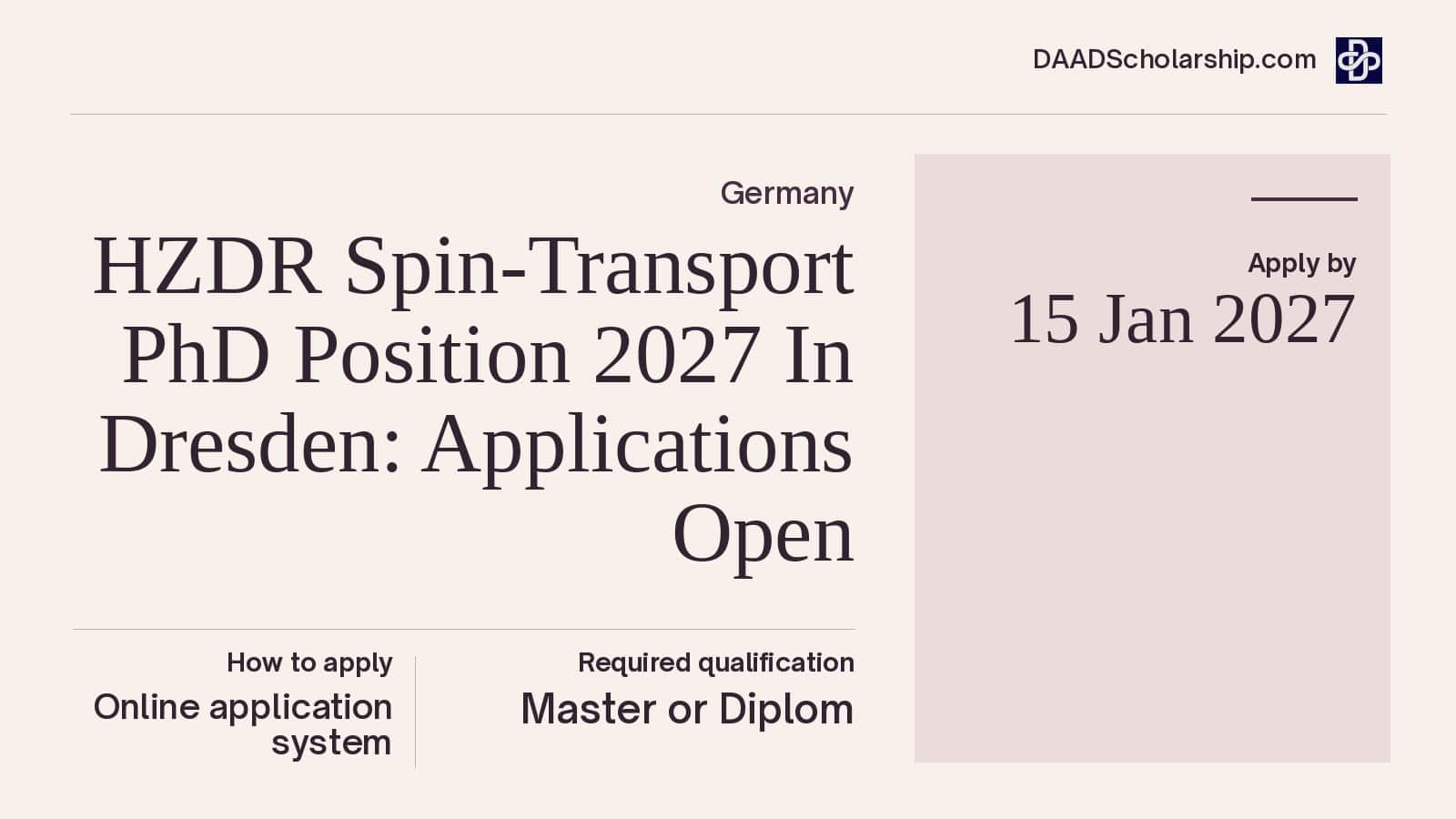
HZDR Spin-Transport PhD
Helmholtz-Zentrum Dresden-Rossendorf’s Dresden High Magnetic Field Laboratory is recruiting one PhD student for a three-year project probing quantum excitations through spin transport. The work combines low-temperature spin Seebeck measurements with device fabrication and materials research; the position is financed and starts on 1 March 2027.
This is a focused experimental-physics role, not a general quantum-science PhD: applicants need a Master’s or Diplom in physics or a related field, and experience in low-temperature experiments, electrical transport or spintronics is relevant. If that describes your background, start assembling the requested motivation letter, CV and certificates now.
What the PhD involves
At the Dresden High Magnetic Field Laboratory (HLD), the HZDR PhD Student position, “Probing Exotic Quantum Excitations via Spin Transport for Future Technologies,” centers on experimental work with quantum spin-chain and spin-liquid systems. The project begins with developing spin Seebeck effect measurements at millikelvin temperatures using a helium-3/helium-4 dilution refrigerator, then applies those measurements alongside related thermodynamic measurements.
The work also includes orienting single crystals with Laue X-ray diffraction and fabricating spin Seebeck devices using optical lithography and platinum sputtering; focused ion beam processing is an alternative fabrication method. Presenting results at international conferences and publishing in peer-reviewed journals are part of the role. In practical terms, this suits someone who wants a hands-on research project that spans measurement, materials preparation and communicating results—not only analysis or theory.
At a glance
- Places
- 1 PhD position
- Duration
- 3 years Starting 1 March 2027
- Financing
- Yes Salary and social benefits under TVöD-Bund
- Working languages
- German and English
Does your background match?
The strongest fit is a graduate of a Master’s or Diplom program in physics—especially experimental or solid-state physics—or a related field. The HZDR profile calls for experience in low-temperature experiments, electrical transport measurements and/or spintronics techniques, together with basic knowledge of quantum mechanics and/or magnetism. Basic programming and data-analysis skills, for example with Python, Origin or LabVIEW, are also requested, as are good spoken and written English.
Should I apply if I have not worked with every technique in the project?
The profile lists experience in low-temperature experiments and/or electrical transport and/or spintronics, and basic knowledge of quantum mechanics and/or magnetism. It does not frame every technique as a must-have. Your application should make the relevant experimental experience and subject knowledge easy to identify.
Match your experience to the project’s measurements, materials work and data analysis before drafting the motivation letter.
That fit test is useful before investing time in the application: a related degree alone is not the whole profile. If your experience connects to one or more of the named experimental areas and you are motivated by fundamental physics research, show that connection clearly rather than presenting a broad, untailored account.
What the position offers
The role is financed, with salary and social benefits according to the German public-sector collective agreement TVöD-Bund. Depending on personal qualifications, the candidate may be classified in salary group 13. The notice also specifies 30 days of paid holiday leave and a company pension scheme (VBL). Because the salary classification depends on qualifications, treat group 13 as a possible classification, not a guaranteed salary level.
Other features may matter when comparing research positions: HZDR describes a structured PhD program with continuing education and networking opportunities, plus flexible working hours, mobile working and the possibility of part-time employment. The offer also includes health-management activities, employee discounts and an employer subsidy for the Deutschland-Ticket Jobticket. These are workplace benefits alongside the research role; they do not replace the salary terms.
Prepare the application package
The application requires a motivation letter, CV and certificates; the broader instruction specifies diplomas and transcripts among the documents. Assemble these as a coherent package so the committee can assess both your academic preparation and experimental fit. The motivation letter is a good place to connect your prior work to the project’s measurement and device-fabrication tasks.
- Prepare a motivation letter focused on your fit with spin transport, low-temperature or related experimental work.
- Update your CV and gather degree certificates and transcripts.
- Submit the complete application through the HZDR online application system.
The HZDR call gives 15 January 2027 as the application deadline and 1 March 2027 as the start date. With one position and a defined research focus, the most useful first move is to review your evidence against the profile, then get the documents ready for the online submission rather than waiting to draft them near the deadline.
Your next opportunity, in your inbox.
Get new scholarship guides and application updates in one daily email. Confirm your choice and unsubscribe whenever you like.
Continuing creates or signs in to your free reader account. Newsletter emails are optional. Terms · Privacy policy


