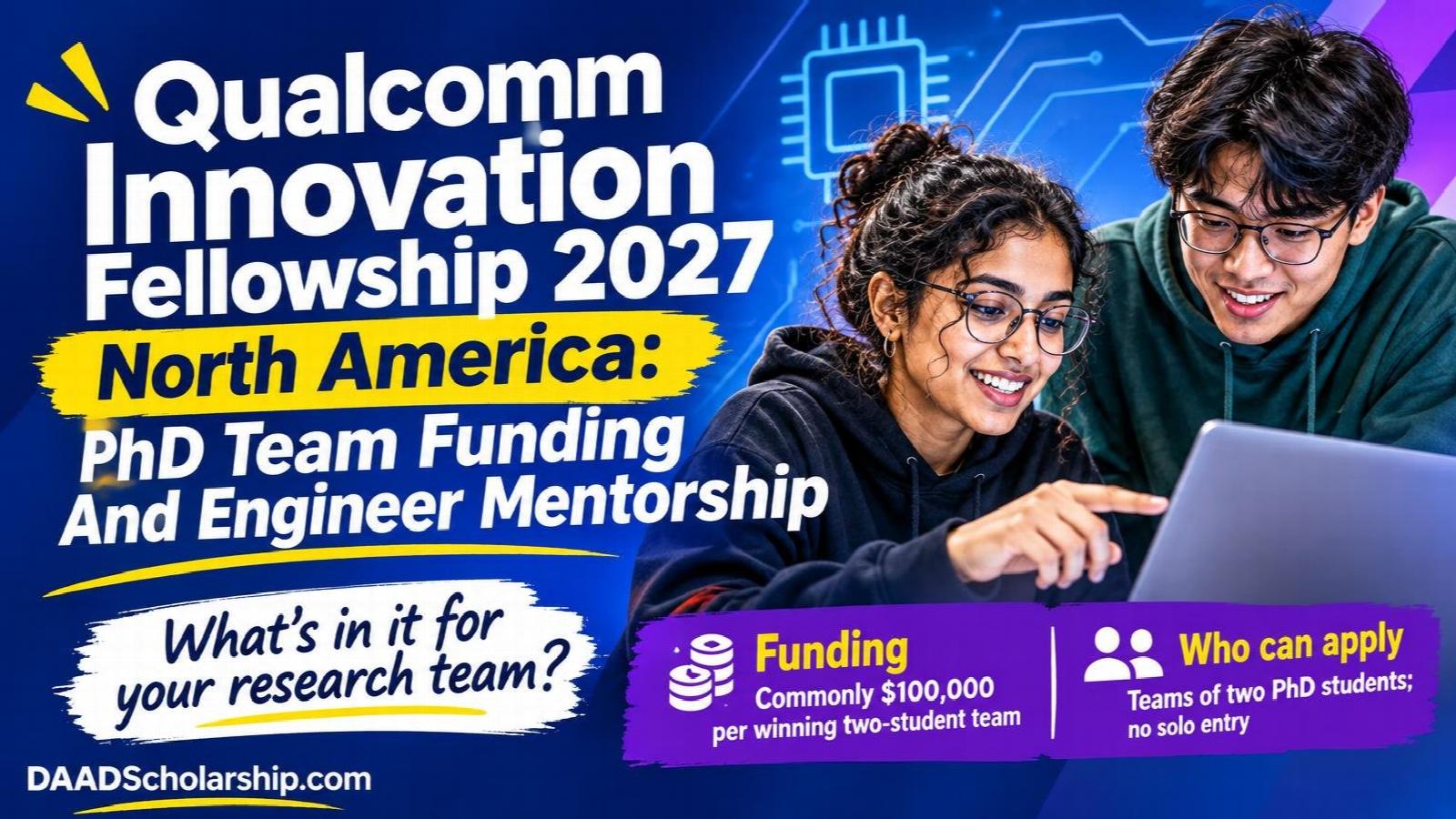
Qualcomm Innovation Fellowship 2027 North America: PhD Team Funding And Engineer Mentorship

Make your next scholarship move.
Get new scholarship guides and application updates in one daily email. Confirm your choice and unsubscribe whenever you like.
Continuing creates or signs in to your free reader account. Newsletter emails are optional. Terms · Privacy policy
See whether your PhD team fits the 2027 Qualcomm Innovation Fellowship
Qualcomm Technologies, Inc. runs the Qualcomm Innovation Fellowship (QIF) for graduate researchers with original technical ideas. In its 2027 North America track, two doctoral students propose a project together; winning teams receive fellowship funding and mentorship from Qualcomm engineers.
What should you know about Qualcomm Innovation Fellowship (QIF) 2027 – North America?
The North America track is for teams of two PhD students at participating universities, not solo applicants. Both students generally need to remain enrolled full-time throughout the fellowship period. Start by checking whether your university participates, then identify a potential teammate whose work strengthens your proposal.
Jump to a section (5)
Is this a fit for your research team?
The Qualcomm Innovation Fellowship 2027 North America track is a team competition tied to participating universities. An international student enrolled full-time at an eligible university may be able to participate, subject to that institution’s rules; nationality alone does not determine eligibility. The practical first check is therefore your university’s participation, followed by whether you and another PhD student can commit to the project together.
Can I enter with an idea of my own?
You can bring an idea to a prospective teammate, but the North America proposal must come from two PhD students. Both generally must be enrolled full-time at participating universities throughout the fellowship period, described for this track as fall 2027 through spring 2028.
Confirm your institution’s eligibility and discuss a shared one-year research plan with a potential teammate before assembling application materials.
That team rule makes the choice of collaborator part of the research case. Reviewers assess not just whether an idea is forward-looking, but whether the proposed team can carry it out. A partner whose contribution is clear will help you explain why this particular pair is likely to succeed.
What does a winning team receive?
Winning teams in the Qualcomm Innovation Fellowship receive funding alongside direct mentorship from Qualcomm research engineers. For North America, the funding is commonly structured around each winning student, but it is directed toward the academic department or fellowship. Treat the figure as fellowship support, rather than assuming it will arrive as a personal cash payment.
North America award structure for a winning team
- Per student
- $50,000 Common North America fellowship funding structure; directed toward the academic department/fellowship.
- Per two-student team
- $100,000 Common combined structure for a winning team, not an individual award.
- Research support
- Engineer mentorship Direct mentorship from Qualcomm research engineers for winning teams.
The mentorship is worth considering alongside the funding: this is a chance to develop an original technical project with researchers working in the field. Before committing time to a proposal, make sure the research question itself excites both teammates; a funding figure cannot substitute for a convincing shared plan.
What work comes first?
The first competition stage asks the Qualcomm Innovation Fellowship team to make its case in a one-page abstract. The abstract needs to explain what is innovative, why it matters and why the two students are likely to succeed. That is a useful test of the idea: if those three points do not fit clearly on one page, refine the project before expanding it.
- Shape the one-page innovation abstract around the idea, its importance and the team’s ability to deliver.
- Prepare a CV or résumé for each student.
- Arrange faculty recommendation letter(s) from one or two faculty members.
- Have both students sign a copy of the QIF rules.
I would ask a potential faculty recommender early enough to discuss the actual project, not merely request a letter at the end. Meanwhile, the two students can develop the abstract and their individual CVs. The faculty letter is someone else’s task; the research argument remains yours.
What follows the abstract?
Shortlisted Qualcomm Innovation Fellowship teams are invited to submit a more detailed proposal, typically three pages plus references or a bibliography. That stage calls for a defined problem, its position relative to existing work, a one-year horizon and evidence that the team can execute the plan. Finalists then present slides and take part in a poster presentation and questions with Qualcomm researchers and judges.
- Step 1Establish team and university fitConfirm participation through your institution and settle on a two-PhD-student research partnership.
- Step 2Build the initial caseDraft the one-page abstract, gather both CVs, arrange faculty recommendation letter(s) and have both students sign the QIF rules.
- Step 3Develop the full proposal if shortlistedExpand the idea into the requested project plan and references after an invitation.
- Step 4Prepare to present if selected as a finalistTurn the project into slides and a poster that can stand up to questions from Qualcomm researchers and judges.
What is the sensible next move for this track?
If you are already involved in that competition, follow the stage relevant to your team. Otherwise, start with the university participation check and a conversation with a potential teammate, rather than preparing a submission for an elapsed first stage. Qualcomm runs separate regional tracks for North America, Europe, India, South Korea and East Asia; their rules and timelines are distinct, so choose the track attached to your university before planning an application.
Read the official program details and application instructions
Your next opportunity, in your inbox.
Get new scholarship guides and application updates in one daily email. Confirm your choice and unsubscribe whenever you like.
Continuing creates or signs in to your free reader account. Newsletter emails are optional. Terms · Privacy policy